Shop

One career pathway.
The same Hopper.

Build Fly Code is a complete autonomous systems curriculum. Students learn to fly, code, and solve real problems with the same drone hardware used from after-school programs through service academies. Every lesson is below.

See example lessons
Teacher and students engaged with Hopper drone
The Pathway
Everyone starts at 00.

Everyone starts with Essentials. From there, Build Fly Code organizes learning by altitude, not by age. Students enter where they are and climb as far as they choose. The same Hopper hardware works at every stage.

00

Start Here, For Everyone: Essentials

The foundation of the entire pathway. Everyone begins with Essentials, every time, even returning students as a refresher. Three parts: Build, Fly, and Code. Build is the mastery core, where students learn every part of the Hopper, from motors and PCB to propellers and battery, so they own the machine before they fly it. Grace puts Essentials first in every plan, no matter what.

  • Required first step for all learners
  • Build, Fly, and Code
  • Build mastery with a full chaptered video series
  • Real programming fundamentals
01

Upper Elementary, Middle, and After-School: Hopper Quest

Twelve hands-on missions for after-school programs and enrichment, 50 to 65 minutes each. Students learn to fly, solve problems, and build confidence before formal coursework begins. The arc runs from a first hover to a scored Search and Rescue finish.

01
Takeoff & Tic-Tac-Toe
Components, safe setup, first flight, and an aerial Tic-Tac-Toe challenge.
02
Precision in Flight
Precision piloting by mimicking flight paths designed by peers.
03
Crack the Code
Why precise instructions matter, guiding an instructor-robot through a maze using written commands.
04
Speeding Through the Square
Applying distance equals rate times time to calculate Hopper's speed in feet per second.
05
Wired for Flight
Designing and flying a custom course from a hand-drawn navigation chart and written flight plan.
06
From Cookies to Conservation
Simulating delivery operations and adapting flight strategy to changing conditions.
07
Emergencies & Payloads
Testing payload capacity and analyzing how added load affects stability and battery life.
08
Next Level Deliveries
Programming Hopper to navigate a course while avoiding obstacles and restricted zones.
09
Builders & Boundaries
Teams split into distinct pilot and programmer roles to complete a shared mission.
10
Iterate to Innovate
Designing and prototyping a lightweight attachment, simulating a window-washing drone.
11
Muddy Emergency
Running the full engineering design process to build a rescue system.
12
Dance Dance to the Rescue
A scored Search and Rescue challenge, landing on numbered pads under time pressure.
  • No prerequisites beyond Essentials
  • Lesson plan, slide deck, and student workbook for every mission
02

Middle to High School: Build Fly Code 2026/27

Five industries, three lessons each, fifteen in total. Every lesson pairs hands-on flight with the industry behind it, and the math is real. Geometry, trigonometry, algebra, functions, and variables all show up because the mission needs them.

Public Safety
Flown as Emergency Response
01
Spot Fires
Using Hopper's camera to locate and map spot fires outside the main fire line.
02
Quench The Flames
Geometry and trigonometry to code Hopper through a series of fire zones.
03
Aerial Ignition
Writing and solving algebraic equations, then coding a prescribed-fire ignition run.
Agriculture
Flown as Precision Agriculture
01
Vertical Farm Inspection
Coding Hopper to inspect vertically stacked rows of crops indoors.
02
Rotational Grazing
Assessing vegetation across six paddocks to support livestock management.
03
Aerial Seeding
How aerial seeding plants cover crops efficiently at scale.
Logistics
Flown as Package Delivery
01
Rural Delivery
Medical delivery to remote areas, and how variables make code adaptable.
02
Organ Delivery
A real medical case study, then coding Hopper through a dense city.
03
For Delivery
Coordinated flight, executed as a team.
Disaster Response
Flown as Search and Rescue
01
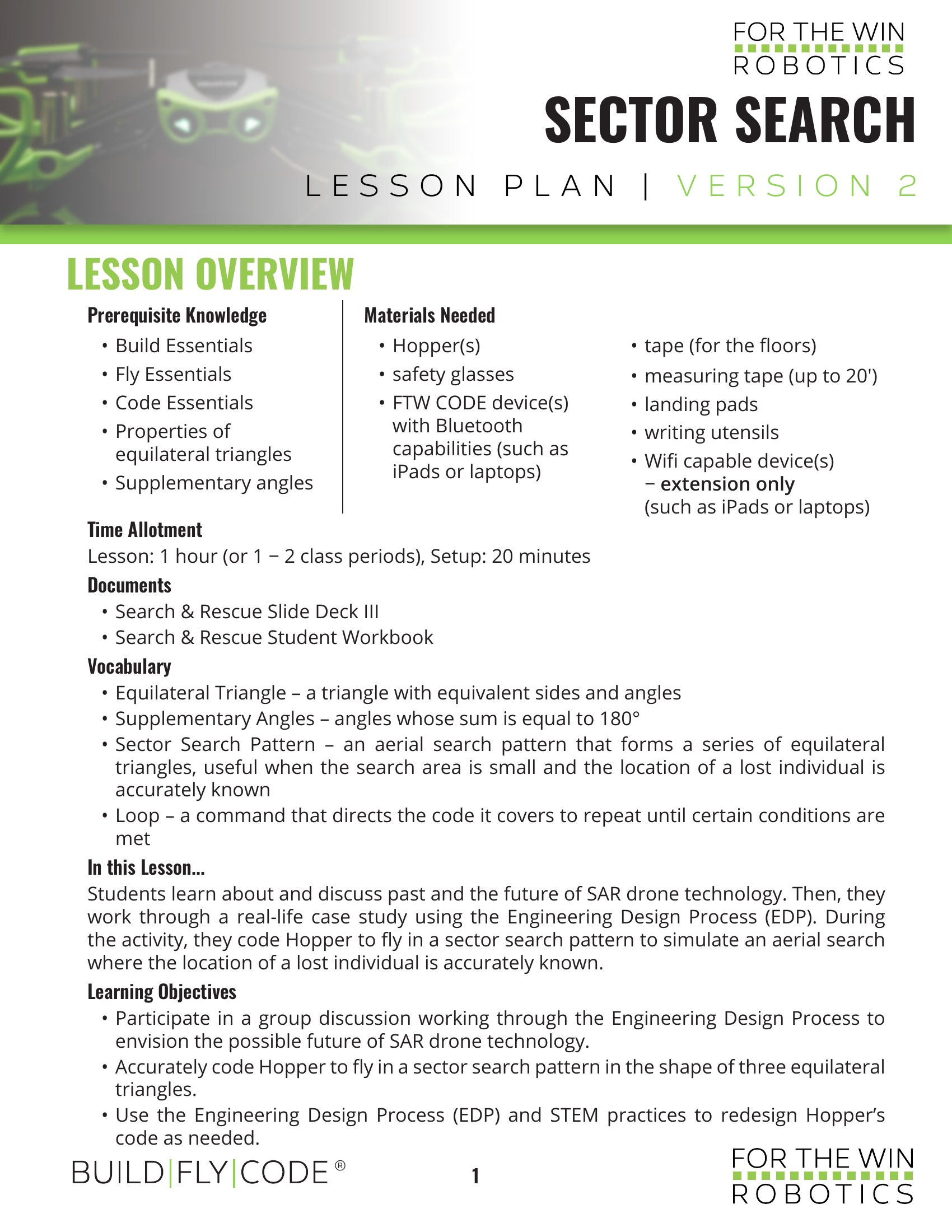
Sector Search
Geometric reasoning applied to a sector search pattern.
02
Parallel Track Search
How parallel track patterns are used to locate missing persons.
03
Expanding Square Search
Coding Hopper to fly an expanding square search.
Infrastructure
Flown as Site Inspection
01
Bridge Inspection
Using functions in code to guide Hopper through a simulated bridge.
02
Aerial Surveying
Identifying key features on a map to support land surveying.
03
3D-Printer Drone
A real construction case study, then coding a simulated 3D printing run.
  • CTE pathway aligned, with embedded formative assessments
  • Lesson plan, slide deck, and student workbook for every lesson
03

High School: FTW Part 107

Part 107 taught as subject matter, not as a cram course. Three missions right now, delivered through scenario-based learning alongside the flight time students have already logged.

01
Airspace
Airspace classification, and the technical skill to identify safe and compliant operational areas.
02
Maintenance
Maintenance fundamentals, pre-flight inspection, and identifying common mechanical issues.
03
Weather
Aviation weather, reading aviation reports, and recognizing hazardous conditions.
  • Scenario-based and paired with real flight
  • Lesson plan, slide deck, and student workbook for every mission
04

Post-Secondary: College, University, and Service Academy

The ladder does not end at graduation. Post-secondary programs put Hopper into a stack of their own design, drawing on the high school material with a light touch. FTW supplies the aircraft, the platform, and the foundation. The coursework around it belongs to the institution.

  • Same hardware students already know
  • High school material available underneath, used lightly
  • Program design stays with the institution
05

No Institution Required: Independent Learner

A learner outside any program can work the whole ladder alone. Homeschool families, career changers, and adults who bought a Hopper for themselves get the same content at the pace they set.

  • Self-paced through every rung
  • No school or cohort needed
  • Runs on hardware you already own
Coming next
Build Fly Code Think

The ladder gains a rung. Think brings reasoning and sensing to the Hopper already sitting in your classroom. This is the part that matters most.

Free, on the Hopper you already own. Soon.

Students don't just learn.
They compete.

Build Fly Code Compete is our national competition. Three challenges, three different skill sets. One is won on the sticks, one with a hook attachment, one entirely in the code editor. They sit inside three of the five industries, but the challenge content is additional to the classroom curriculum, not a repeat of it. The fall window of the 2026/27 season is coming. Same Hopper. New stakes.

See the Competition →
What You Get
Ready to teach by Friday

Every lesson comes with everything an educator needs. No curriculum development required.

Teacher Lesson Plan

Teacher Lesson Plan

Detailed, case-study-based lessons with setup schematics, extension activities, embedded formative assessments, and sample responses. Everything you need to deliver engaging, standards-aligned instruction.

Teacher Slide Deck

Teacher Slide Deck

Each lesson includes a slide deck that provides real-world context, outlines key details, and sets clear expectations for each phase of execution. Check-for-understanding questions are embedded throughout.

Student Workbook

Student Workbook

Available in digital and printable formats. Students log data, respond to scenario-based questions, and reflect on their findings during each simulation.

Build Fly Code Curriculum

Sample Lessons

One lesson from each rung of the ladder. Download the teacher lesson plan, slide deck, and student workbook to see exactly what students do at every level.

Hopper Quest
Takeoff & Tic-Tac-Toe
Lesson 1. Students get airborne for the first time and learn to navigate Hopper through a tic-tac-toe pattern on the ground.
Lesson Plan → Slide Deck → Student Workbook →
Precision Agriculture
Vertical Farm Inspection
Lesson 1. Students explore how drones support modern indoor agriculture and code Hopper to inspect vertically stacked rows of crops.
Lesson Plan → Slide Deck → Student Workbook →
FTW Part 107
Airspace
Mission 1. Students define airspace classification and develop the technical skills required to identify safe and compliant operational areas.
Lesson Plan → Slide Deck → Student Workbook →
Build Fly Code Compete
National Competition
Three real-world challenges drawn from the curriculum: Emergency Response, Search and Rescue, and Package Delivery. Teams compete on a national leaderboard.
Slide Deck → See the Competition →
Live video support from the team that built it.

Curriculum, programming, hardware, software. Bring us a lesson that will not run, code that will not compile, or a Hopper that will not fly right, and you get a live person on video. Not a ticket number. The team that builds all of it.

Ask Grace
Talk to the expert who knows the whole catalog.

Teaching a class, homeschooling, or building a summer camp? Grace knows the FTW curriculum cold, every lesson across Build Fly Code, Hopper Quest, Part 107, and Essentials. Tell her your grade level, your schedule, and what you have, and she will advise you on where to start, what to run, and how to pace it across your weeks. Ask her anything. She is the expert, and she is right here.

Procurement and Compliance

Grant Ready. Compliance Cleared.

Build Fly Code is built for institutional adoption. Every component meets the compliance, documentation, and funding requirements that program directors and district procurement offices need.

Perkins V Eligible

Hopper hardware and BFC curriculum qualify as CTE equipment and instructional materials under the Strengthening Career and Technical Education for the 21st Century Act. FTW provides grant documentation support for district procurement offices.

NDAA Section 889 Compliant

Hopper is not exposed to components from prohibited foreign manufacturers, making it fully compliant with NDAA Section 889. Eligible for use in Title I schools, JROTC programs, federally funded workforce contracts, and defense-adjacent curricula.

Purchase Order Accepted

FTW Robotics accepts purchase orders and works directly with district procurement teams. Quote requests, sole-source justification letters, and compliance documentation are available upon request.

Request a Quote or Grant Docs

Site Feedback

Help us improve ftw-robotics.ai

Educator Services

Grant Research

Tell us about your program. We will research local and national grant opportunities specific to your situation and share our findings with you directly.

Federal funding for your program type and institution
State-level CTE, workforce, and ed-tech grants in your state
Foundation and private grants aligned to drone education
Eligibility notes and relevant deadlines
FIND MY GRANTS
No automated replies. We review and respond directly.